Austria has an extensive and well-maintained motorway network connecting Vienna, Salzburg, Graz, Innsbruck and other major cities with Germany, Italy, Switzerland, Slovenia, Hungary, Slovakia and the Czech Republic.
However, most Austrian motorways and expressways are not free to use. Cars, motorcycles and many campervans require an Austrian motorway vignette. In addition, several Alpine tunnels and mountain motorway sections have separate tolls.
This guide covers everything you need to know before travelling by car in Austria: motorway tolls, vignette prices, where to buy a vignette, fuel prices, speed limits, parking, insurance, vehicle equipment, winter tyres, travelling with children and travelling with dogs.
General Information
Austria drives on the right-hand side of the road, with overtaking normally performed on the left.
The motorway network is operated mainly by ASFINAG and includes Autobahnen (motorways) and Schnellstraßen (expressways).
For most passenger vehicles with a maximum technically permissible laden mass of up to 3.5 tonnes, Austria uses a vignette system.
A vignette is generally required for:
- passenger cars;
- motorcycles;
- SUVs;
- vans up to 3.5 tonnes;
- many campervans and motorhomes up to 3.5 tonnes.
Vehicles above 3.5 tonnes are generally subject to a distance-based toll system.
Toll Roads in Austria
Most Austrian motorways and expressways require a valid vignette.
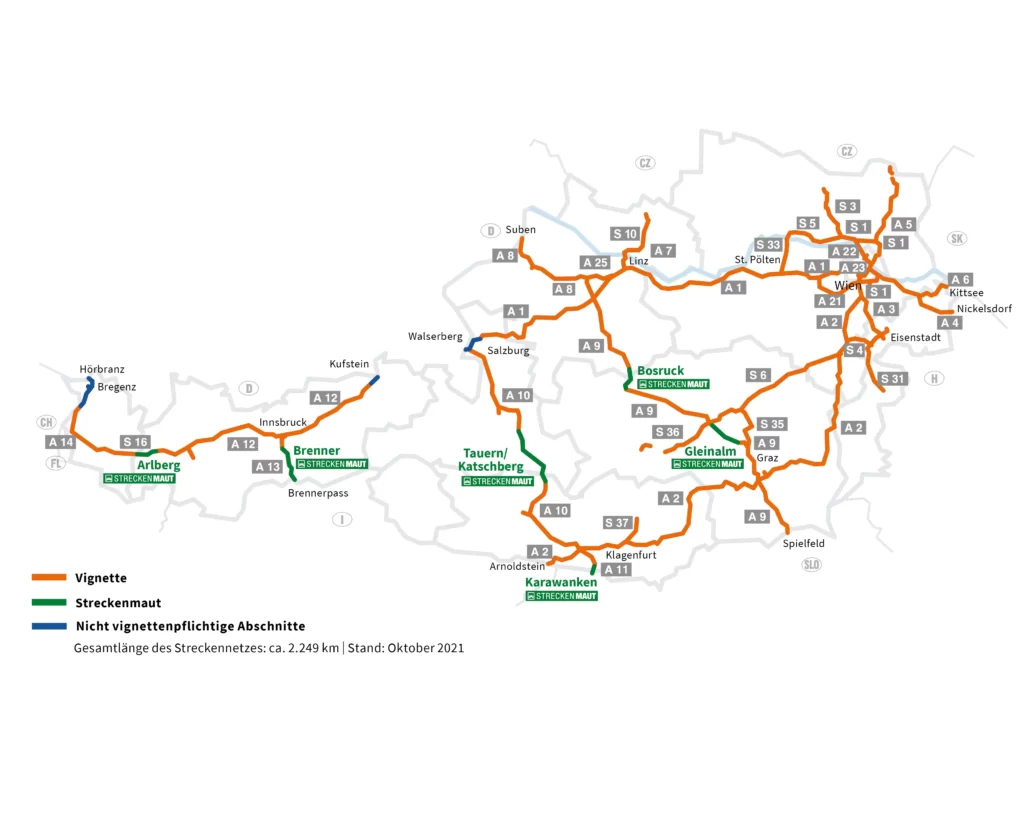
Important Austrian motorway routes include:
| Motorway | Main Route |
|---|---|
| A1 | Vienna – Linz – Salzburg |
| A2 | Vienna – Graz – Italy direction |
| A4 | Vienna – Hungarian border |
| A8 | Wels – German border |
| A9 | Graz – Linz |
| A10 | Salzburg – Villach |
| A12 | Kufstein – Innsbruck |
| A13 | Innsbruck – Brenner Pass |
| A14 | Vorarlberg |
Some Alpine motorway sections are subject to an additional section toll (Streckenmaut).
This applies to important routes including parts of:
- A9 Pyhrn Autobahn;
- A10 Tauern Autobahn;
- A11 Karawanken Autobahn;
- A13 Brenner Autobahn;
- S16 Arlberg expressway.
These routes contain expensive tunnels and Alpine crossings, so check whether an additional section toll applies before travelling.
Austria Vignette Prices
For passenger cars and vehicles up to 3.5 tonnes, the vignette prices are:
| Vignette | Car | Motorcycle |
|---|---|---|
| 1 day | €9.60 | €3.80 |
| 10 days | €12.80 | €5.10 |
| 2 months | €32.00 | €12.80 |
| Annual | €106.80 | €42.70 |
The 1-day vignette is available only as a digital vignette.
For tourists crossing Austria or staying for a short holiday, the 10-day vignette is often the most convenient option.
Where to Buy an Austrian Vignette
The safest way to buy an Austrian motorway vignette online is through the official ASFINAG Toll Shop.
You can also purchase Austrian vignettes at many:
- petrol stations in Austria;
- petrol stations near the Austrian border;
- ASFINAG sales points;
- automobile clubs;
- authorised sales partners.
Two types of vignette are available.
Adhesive vignette
The traditional vignette is attached to the inside of the windscreen.
It must be placed correctly according to the instructions. Simply keeping the sticker inside the vehicle is not sufficient.
Digital vignette
The digital vignette is linked electronically to your vehicle’s licence plate number.
Nothing needs to be attached to the windscreen.
How to Buy an Austrian Digital Vignette
Buying a digital vignette online is simple:
- Open the official ASFINAG Toll Shop.
- Select Digital Vignette.
- Choose car or motorcycle.
- Select the required validity period.
- Select the start date.
- Enter the vehicle registration country.
- Enter the licence plate number.
- Check the information carefully.
- Pay online.
- Save the purchase confirmation.
Make sure the registration number and country are entered correctly.
Digital vignette activation
An important rule applies when private consumers purchase certain digital vignette products online.
The 2-month and annual digital vignettes may be subject to a consumer withdrawal period, meaning they normally cannot become valid immediately after an online consumer purchase.
The 1-day and 10-day digital vignettes can be purchased for immediate use.
If you are travelling to Austria at short notice, check the selected validity date carefully before paying.
Do I Need a Vignette and an Additional Toll?
Sometimes you need both types of road payment during the same journey.
Austria uses:
Vignette – for most motorways and expressways.
Section toll (Streckenmaut) – for certain expensive Alpine motorway sections, tunnels and mountain crossings.
Routes involving the Brenner, Tauern, Pyhrn, Karawanken or Arlberg corridors should therefore be checked before departure.
Driving Without an Austrian Vignette
Do not enter a motorway requiring a vignette unless your vehicle has a valid vignette.
Austria uses automatic and manual controls to identify vehicles without valid motorway toll payment.
If you use a toll road without the required vignette, you may have to pay a replacement toll. More serious cases can result in significantly higher administrative penalties.
For digital vignettes, always verify:
- licence plate number;
- registration country;
- vehicle category;
- validity period;
- activation date.
Speed Limits in Austria
General speed limits for passenger cars are:
| Road Type | Speed Limit |
|---|---|
| Built-up areas | 50 km/h |
| Outside built-up areas | 100 km/h |
| Motorways | 130 km/h |
Lower limits may apply depending on road conditions, location and environmental regulations.
Drivers will frequently encounter limits of:
- 30 km/h;
- 60 km/h;
- 80 km/h;
- 100 km/h.
Austria also uses environmental IG-L speed limits on certain motorway sections.
Always follow the speed shown on road signs and electronic motorway displays.
Fuel Prices in Austria
Petrol stations are widely available throughout Austria. You can find stations in cities, villages, near motorway exits and directly at motorway service areas.
The two most common fuels are:
- Super 95 (E10) – standard unleaded petrol;
- Diesel.
Typical current prices are approximately:
| Fuel | Typical Price per Litre |
|---|---|
| Super 95 | about €1.75–€1.90 |
| Diesel | about €2.00–€2.15 |
| Premium petrol | about €2.00–€2.20 |
| Premium diesel | about €2.15–€2.35 |
Fuel prices change frequently and vary considerably between individual petrol stations and regions.
Austria’s official E-Control data currently puts the nationwide median at approximately €1.77/litre for Super 95 and €2.03/litre for diesel.
Fuel Prices at Austrian Petrol Stations
Austria has a large number of petrol station chains, including OMV, Shell, BP, Eni and numerous independent operators.
Typical prices can look like this:
| Petrol Station | Super 95 | Diesel |
|---|---|---|
| OMV | around €1.83/L | around €2.09/L |
| Shell | around €1.85/L | around €2.10/L |
| BP | around €1.84/L | around €2.09/L |
| Eni | around €1.83/L | around €2.08/L |
| Independent stations | often €1.75–€1.85/L | often €2.00–€2.10/L |
These are indicative prices rather than fixed prices. Actual prices depend on the station, region and time of day. Recent nationwide station data shows branded stations such as OMV, Shell and BP tending to be somewhat more expensive than the national average.
Are Motorway Petrol Stations More Expensive?
Usually, yes.
Petrol stations located directly on Austrian motorways and major transit routes can be noticeably more expensive than stations in nearby towns.
If you are not in a hurry, leaving the motorway and driving a few kilometres to a local petrol station can reduce your fuel costs.
This can make a significant difference when filling a 50–70 litre fuel tank.
Example of Fuel Prices at an Austrian Station
Prices vary even between stations belonging to the same company.
For example, a Shell station in Vienna recently listed approximately:
- Super 95 – €1.79/L;
- Diesel – €2.04/L;
- premium petrol – €2.05/L;
- V-Power Diesel – €2.30/L.
This illustrates why comparing prices before filling up can be worthwhile.
How to Find Cheap Fuel in Austria
Austria has an official fuel price comparison service operated by E-Control.
The service allows drivers to search for cheaper petrol stations by address, district or federal state.
Reported prices in the official database are kept very current: according to E-Control, price reductions must be reported promptly, and the database’s displayed fuel-price information should not be older than 30 minutes.
Best Time to Refuel in Austria
There is another useful rule for drivers.
Fuel price increases in Austria are generally permitted once per day at 12:00 noon, while price reductions can occur during the day.
This means comparing stations before refuelling can save money, especially when buying a full tank.
Parking in Austria
Parking regulations differ between Austrian cities.
Many cities use short-term parking zones called Kurzparkzone.
Depending on the location, drivers may need to:
- purchase a parking ticket;
- use a parking meter;
- pay through a parking application;
- respect a maximum parking period.
Vienna has extensive regulated parking areas.
Controlled parking is also common in Salzburg, Graz, Innsbruck and other popular tourist destinations.
Park & Ride (P+R) facilities are often a cheaper and easier option when visiting larger cities.
Car Insurance in Austria
Vehicles travelling on Austrian public roads must have valid motor liability insurance.
Foreign drivers should carry:
- driving licence;
- vehicle registration certificate;
- proof of insurance;
- passport or national identity document where required.
Drivers arriving from outside the EU/EEA should check whether additional international insurance documentation or a Green Card is required.
Required Vehicle Equipment
Before entering Austria, make sure your vehicle has the necessary safety equipment.
Important items include:
- warning triangle;
- first-aid kit;
- reflective safety vest.
Keep the reflective vest somewhere accessible from inside the vehicle.
For winter journeys, it is also recommended to carry:
- ice scraper;
- gloves;
- snow brush;
- winter windscreen washer fluid;
- snow chains when travelling in Alpine regions.
Winter Tyres in Austria
Between 1 November and 15 April, passenger cars and vehicles up to 3.5 tonnes must use winter tyres on all wheels when winter road conditions exist.
Winter conditions include:
- snow;
- slush;
- ice.
For common radial winter tyres on cars, the required minimum winter tread depth is 4 mm.
Snow chains may also be required on certain mountain roads when indicated by road signs.
Conditions in the Austrian Alps can change quickly, so drivers travelling to ski resorts should prepare accordingly.
Transporting Children in Austria
Children must be properly secured while travelling in a vehicle.
Children who are under 14 years old and shorter than 135 cm must use an appropriate child restraint system.
Depending on the child’s age and size, this can include:
- baby carrier;
- child car seat;
- booster seat.
Children under 14 who are taller than 135 cm must use a seat belt.
Each child must have their own seat.
Can a Child Travel in the Front Seat?
A child seat may be installed on the front passenger seat.
However, a rear-facing child seat must never be placed in front of an active passenger airbag.
The airbag must be deactivated where required.
Travelling with a Dog in Austria
Dogs and other pets should be transported in a way that prevents them from interfering with the driver and protects passengers during sudden braking or an accident.
Suitable options include:
- dog transport crate;
- secured dog harness;
- luggage compartment barrier.
A dog should not be allowed to move freely around the passenger compartment while the vehicle is moving.
When entering Austria from another country, also check applicable EU animal travel regulations.
Depending on the journey, you may need:
- microchip;
- valid rabies vaccination;
- EU pet passport or appropriate animal health documentation.
Rules concerning leads and muzzles can vary depending on the Austrian region, municipality and public transport operator.
Driving a Campervan or Motorhome in Austria
Motorhome drivers should pay particular attention to the vehicle’s maximum technically permissible laden mass.
Vehicles within the up to 3.5-tonne vignette category generally use the normal vignette system.
Heavier vehicles are subject to Austria’s distance-based road toll system.
Always check your vehicle registration documents before travelling.
Useful Tips for Driving in Austria
Before starting your journey:
- buy your motorway vignette;
- check whether your route includes a separately tolled tunnel;
- compare fuel prices before filling up;
- avoid expensive motorway petrol stations when possible;
- check winter tyre requirements;
- carry required safety equipment;
- verify your insurance;
- check weather and Alpine road conditions.
During motorway congestion, remember to form the Rettungsgasse (emergency corridor) for police, ambulances and other emergency vehicles.
Frequently Asked Questions
Do I need a vignette in Austria?
A vignette is generally required for passenger cars and other qualifying vehicles using Austrian motorways and expressways.
How much does an Austrian vignette cost?
A car vignette costs €9.60 for one day, €12.80 for 10 days, €32.00 for two months and €106.80 for an annual vignette.
Where can I buy an Austrian vignette?
You can buy one through the official ASFINAG Toll Shop, at authorised sales outlets and at many petrol stations.
Can I buy a vignette at a petrol station?
Yes. Many Austrian petrol stations and stations close to the Austrian border sell motorway vignettes.
How much is petrol in Austria?
Super 95 typically costs around €1.75–€1.90 per litre, although prices vary by location and petrol station.
How much is diesel in Austria?
Diesel is currently typically around €2.00–€2.15 per litre, depending on the station and region.
Is fuel more expensive on Austrian motorways?
Motorway service stations are generally more expensive than many petrol stations in towns and near motorway exits.
What is the speed limit on Austrian motorways?
The general motorway speed limit for passenger cars is 130 km/h, unless signs indicate otherwise.
Are winter tyres mandatory?
Winter tyres are required for passenger cars during winter road conditions between 1 November and 15 April.
Do children need car seats?
Children under 14 and shorter than 135 cm must use an appropriate child restraint system.
Toll Roads in Austria – Summary
Travelling by car through Austria is relatively easy, but drivers should understand the country’s motorway toll system before departure.
Most cars require a motorway vignette, while certain Alpine tunnels and motorway sections require an additional toll.
Fuel is widely available from OMV, Shell, BP, Eni and independent petrol stations. Prices can differ considerably, so comparing stations and leaving the motorway to refuel can often save money.
Drivers should also pay attention to speed limits, parking regulations, winter tyre requirements, child restraint rules and the safe transportation of pets.